Episode Transcript
[00:00:02] Speaker A: I love portalero.
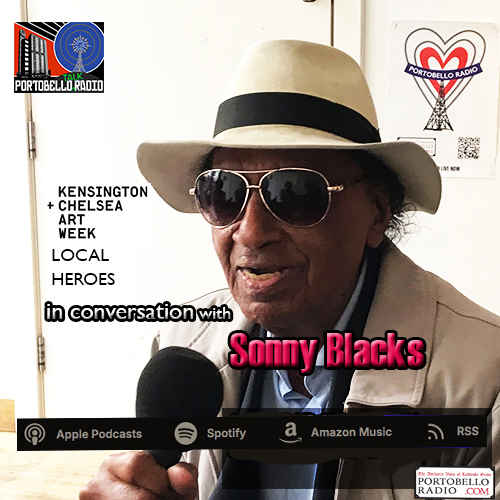
[00:00:09] Speaker B: Now I'm joined by another one of the Kensington Art Weekend heroes, Sonny Blacks. Welcome, Sonny.
[00:00:16] Speaker A: Hi. Thank you.
[00:00:18] Speaker B: Now, Sonny, you, I believe, were in the very first steel band to come to the UK and to Notting Hill.
[00:00:25] Speaker A: Not factually, but with the first steel band that came and settled in the United Kingdom.
That was the Dixieland Steel Orchestra, having won the music festival and the island wide competition in Trinidad.
And then we came to London.
[00:00:45] Speaker B: And you stayed when we came to.
[00:00:47] Speaker A: London because in Trinidad, when Princess Margaret got married, we played for her, so we had a connection with her.
And then we used to perform in a club on Queensway called the Ambience and at the Ambient. Princess Margaret and her entourage used to come there very regularly, a couple times a week.
[00:01:11] Speaker B: Wow, that sounds fabulous. That's very glamorous.
[00:01:14] Speaker A: Yes. And then we went on to play at the Savoy, which no other steel band have ever emulated.
We played with Maurice Chevalier.
[00:01:25] Speaker B: Ooh.
[00:01:26] Speaker A: Very, very big.
[00:01:28] Speaker B: And those big names keep coming.
[00:01:31] Speaker A: Yes, yes.
We really introduced steel band to Europe under my management. We went all over Europe and was the first steel band from England that went to Africa.
First steel band in the world.
[00:01:49] Speaker B: And where did you go in Africa?
[00:01:50] Speaker A: We went to Rhodesia. We flew into Rhodesia and played for the President and a couple other performances and then came back to London.
[00:02:03] Speaker B: And then a little later on you were involved at the beginning of Carnival?
[00:02:07] Speaker A: Yes, but we was always involved with Carnival in Trinidad. Carnival is part of our heritage.
And therefore the story really begin again with the same ambience where we used to play.
And Mrs. Laslett, having run the children's fair, a lady with vision who wanted to incorporate the new people into the society and she wanted a steel ban and therefore she went to the High Commissioner, which is the right place to go.
And then he recommended Junior Telfer, who had been the manager of the Ambiance, where we said Princess Margaret and other top people used to come to enjoy proper nice music.
And therefore Junior Telfer was introduced to Mrs. Lazar and he recommended Russell Henderson, who was playing in this pub called the Culhearn in Earls Court was a very famous place that was a magnet for musicians from the whole of England to come on a Sunday and jam.
And therefore with the invitation from Mrs. Lassett, we all who were there came from Earl's Court to Portobello Road to participate in the first carnival.
[00:03:38] Speaker B: And then a couple years later, you were part of the first organizing committee.
[00:03:43] Speaker A: A couple years after, Russell Henderson asked me to form a committee to run the carnival. But One has to go back in time to realize at that time we didn't have much Caribbean people, very few and far between.
And I said, okay, I will do it. And I did.
And we convened a meeting and we had a constitution, and I was elected the first chair. But because I was traveling at the time between here and Denmark, Leslie suggested one of the members was there to ask Selwyn Batiste to be the first elected chair of that committee. And it was very small. It was nothing.
Nobody could have visualized that Carnival would have developed to such a big thing. Nobody, including myself.
[00:04:41] Speaker B: Will you sully be it? Leslie Palmer runs his Carnival Pioneers Festival in North Kensington on August 12th or 13th. Will you be there?
[00:04:53] Speaker A: It's a very ticklish. Leslie Palmer came in late and he did a good job.
But what have happened? Carnival in the early days was comprised of music.
We had a lot of music. Steel band, calypso orchestras and a few masqueraders. But people came to hear music.
And when Leslie Palmer came in, he brought in the sound system. And in my opinion, it had changed the whole concept of Carnival because it attracted. Maybe it brought more people in also. It attracted a different element.
And that's what I would like to say about that, the sound system.
[00:05:41] Speaker B: Is it fair to say that the.
The steel bands and the calypso was more of a Trinidadian thing and the sound system was more of a Jamaican thing?
[00:05:52] Speaker A: That's correct. But you must remember, sound system is a new thing that came in.
We didn't have sound system in my time. Even when I came to England in this area, in the Notting Hill area, we had blues. A little blues party. That's where it started.
We had blues party. Then we have the song system. Then we had the clubs with like countsattle club and different club. And sound system being a Jamaican thing. It was a completely different thing to our culture. It's a new thing, and the young people seems to be involved in it. But it has a history.
It hasn't got a cultural history like Steel Barn and Carnival.
[00:06:42] Speaker B: Briefly, before we part, could you just. What was it like coming to Notting Hill as a young man from the Caribbean in the early 60s?
[00:06:51] Speaker A: Very frightening.
I mean, I came out at Victoria Station, and in those days we had gas lamps, right? Because people say, light it and out it in the morning.
And I came out at Victoria Station and I said, where is London?
And the guy said, you're in London. You're in the heart of London. I couldn't believe it. I said, well, where's the lights. Now, remember, 61 is just a few years after the war.
Everything was still in gloomy and black and white and they said, if you want lights, you gotta go Piccadilly Circus.
That is where you see lights.
And we were still under with fog and dim, dull. People were still wearing black and if you were wearing something color, people were really going to come out of shops and look at you.
[00:07:49] Speaker B: And then what about getting accommodation, jobs? I mean, you were in a band, so.
[00:07:54] Speaker A: Well, you wouldn't believe this. Accommodation was not up to standard.
But at least you could have got a room.
I mean, I live all over Notting Hill.
Room was about 2 pound 53, but it was linoleum floor and paraffin heater and you put a shilling in there and when it run out, you have to freeze till next morning when you had a bottle to fill.
When that you put 2, 3 shillings or whatever you could afford.
I remember we had no benefits.
We weren't given any scholarships or anything to learn or to develop.
If you didn't pay your rent, the bailiffs would come and seize everything except the bed. They take the television. But now the new people who are coming in from foreign country, foreign to England, and they are getting much more benefit than the English people, people who are born here for generation 100, 200 years, poor people are still suffering in comparison to what they should be getting.
[00:09:12] Speaker B: There's a song called Brand New Cadillac by Vince Taylor and the Playboys which talks about. The guy talks about his girl coming up in a brand new Cadillac. Now, I've always thought that. I've always understood that as a reference to saying that she turns up with a black guy, because if you were Jamaican or American, there were GIs, you were allowed to buy a Cadillac, whereas if you were from the uk, you couldn't own a Cadillac.
[00:09:41] Speaker A: That showed you, shows you how things are. Well, yeah, but it was better in a lot of ways. We were safe.
We were safe. We could have walked anywhere. Here in Notting Hill, in London, we could have walked anywhere. I mean, before my time, of course. We had teddy boys and Kelso Cochrane got killed around the corner. But afterward it settled down and when people love, we bought love and music and life.
And people had loved to have Caribbean friends because they knew they were going to be an enjoyable time whenever we meet, you must remember in those days, it was before drugs, so we only had one bottle of red wine and we were quite happy.
[00:10:30] Speaker B: So you were here basically after the riots, when the community here was beginning to come together, they'd had the violence of two or three years earlier and people begin to appreciate each other.
[00:10:44] Speaker A: Well, yes, yes, yes, yes, very much so.
[00:10:48] Speaker B: Great. Well, thank you very much, Sunny.
[00:10:51] Speaker A: I mean, you're welcome.
[00:10:52] Speaker B: We look forward to many more years of Carnival and I hope many more years of. Of diverse harmony here in Notting Hill.
[00:11:00] Speaker A: Good. Thank you very much.
[00:11:01] Speaker B: My pleasure.
[00:11:05] Speaker A: The official state broadcaster of the People's.
[00:11:07] Speaker B: Republic of North Kensington, where the truth.
[00:11:10] Speaker A: Comes first, the future is yet to be written.